Enriching irrigation water with dissolved oxygen sounds almost too simple. Yet the research base is now substantial: across more than two decades of peer-reviewed trials, oxygenated irrigation water has produced yield gains ranging from modest to dramatic across cotton, soybean, maize, tomato, cucumber, pineapple, potato, and more. In some trials the gain approaches 30%. In others, nothing happens at all.
Understanding that gap — why oxygenated irrigation works in some fields and not others — is the key to deciding whether it's worth evaluating on your own operation. This guide is written as an independent resource, not a product pitch: it explains the mechanism, summarises the evidence including the null results, and gives growers and agronomists a practical framework — including a field method — for assessing whether their own root zone is oxygen-limited.
Photosynthesis fixes carbon above ground. Root function, by contrast, is powered almost entirely by aerobic respiration — the same oxygen-consuming process that drives animal metabolism. Root cells use oxygen to produce ATP, the cellular energy currency behind every downstream function: water absorption, mineral uptake, elongation into new soil volume, and the membrane integrity that keeps salts out and nutrients in.
When soil oxygen falls below roughly 10% by volume — a condition called hypoxia — root metabolism shifts toward anaerobic pathways that are energetically inefficient and produce toxic fermentation by-products. Water and nutrient uptake drop, root growth slows, and the plant above ground shows symptoms often misread as drought stress, nutrient deficiency, or disease.
One of the first visible symptoms of root-zone oxygen deficiency is wilting — even in wet soil. When roots can't respire aerobically, they lose the energy to pump water against osmotic gradients. A wilting crop on a freshly irrigated field is often a hypoxia signal, not a drought signal.
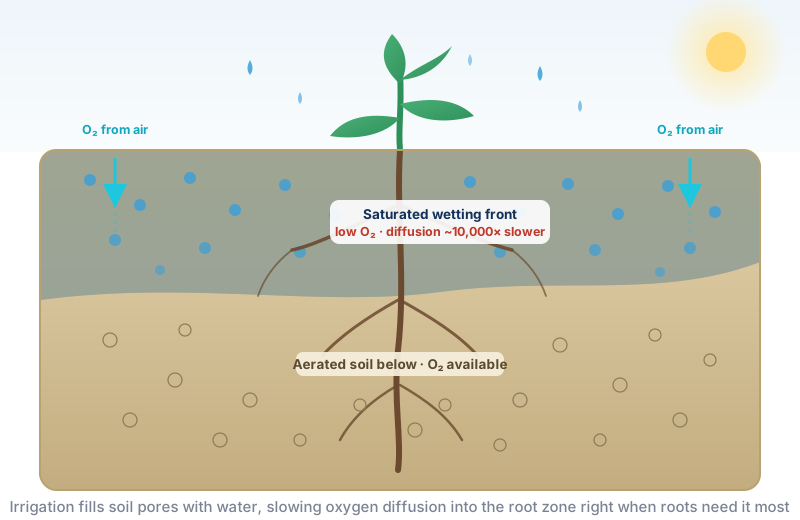
How irrigation itself depletes soil oxygen. Every irrigation event fills soil pores with water, physically displacing the air that was there. Oxygen can then only re-enter by diffusing through the water-filled matrix — roughly 10,000 times slower than diffusion through air. How fast the soil re-aerates after an irrigation event determines whether roots experience meaningful hypoxia. Three factors dominate that recovery rate:
Clay and silt particles pack tightly, leaving small pores that fill completely with water and drain slowly. Sandy soils have large pores that drain rapidly and re-fill with air within hours.
A drip system running daily or every two days may never allow the wetting front to dry sufficiently for re-aeration. Flood and furrow irrigation applies water less frequently, allowing longer dry-down intervals.
Warm soils with high microbial activity consume oxygen faster. Treated wastewater, rich in organic carbon, dramatically accelerates biological oxygen demand in the root zone.
Oxygenated irrigation — also called oxygation — refers to delivering dissolved oxygen to the crop root zone via the irrigation stream itself, rather than relying on soil re-aeration from the surface. Several technologies can achieve this, with meaningfully different performance characteristics:
A pressure differential draws air into the flow, creating macro-bubbles in the line. Simple and low-cost, but dissolved oxygen levels are modest and bubble longevity is short — most injected gas escapes before it dissolves.
Air pumps and diffusers achieve higher dissolved oxygen concentrations than venturi systems but are typically limited to near-emitter zones.
H₂O₂ releases oxygen as it decomposes in soil. Effective, but carries phytotoxicity risk at high concentrations — particularly in clay soils with metal catalyst surfaces (see Section 4).
Produce sub-200 nm bubbles with enormous gas-water surface area per unit of gas volume — the same surface-area-to-volume physics that governs gas transfer generally. Because dissolution happens before any bubble migration is physically significant, nanobubble aeration achieves near-complete oxygen transfer in a single pass, and the dissolved oxygen is then carried into the soil profile by the convective transport of the wetting front — the same mechanism that carries water and nutrients to depth. The most consistent delivery mechanism in current research.
Ambient water at 20°C holds approximately 9 mg/L (ppm) of dissolved oxygen at saturation. Oxygenation treatments studied in the literature typically range from 10 to 25 mg/L (supersaturated), with nanobubble-based systems generally achieving the highest transfer efficiency at these concentrations, since near-complete transfer isn't strongly temperature-dependent the way conventional aeration is.
Oxygenated irrigation increases yield when and because the root zone is already oxygen-limited under standard irrigation practice. Where soils are inherently well-aerated, supplemental dissolved oxygen delivers no measurable agronomic advantage. Studies reporting null results cluster systematically in well-aerated growing media and coarse-textured soils; studies reporting positive results cluster in fine-textured, poorly-drained, compacted, saline, or high-frequency-irrigated environments where root-zone hypoxia is the norm.
Stated differently: oxygenated irrigation is a targeted remedy for a specific bottleneck, not a general growth stimulant. The magnitude of the yield gain is proportional to the severity of the oxygen deficit it corrects.
Heavy clay and Vertosol soils. The strongest and most consistent yield responses in the literature come from heavy clay soils — particularly Vertosols, the dominant soil type in irrigated cotton production across Australia and comparable regions worldwide. Under subsurface drip irrigation, the wetting front around emitters can remain saturated for days, creating sustained root-zone hypoxia. A seven-season broadacre field trial of cotton oxygation on a Vertosol at Emerald, central Queensland, produced consistent yield improvements via aerated subsurface drip water — one season recorded 27% more lint and 26% greater water-use efficiency compared to non-aerated controls (Pendergast, Bhattarai & Midmore 2013). A separate study directly comparing the oxygation response in a vertisol against a ferrosol (a more structured, better-drained red soil) using identical crops and protocols found yield, water-use efficiency, and root zone oxygen all significantly greater in the vertisol — consistent with lower baseline oxygen limitation in the better-drained soil (Chen et al. 2011).
Saline soils. Salinity and root-zone hypoxia are a damaging combination. Saline soils typically require elevated irrigation volumes to leach salt below the root zone, which keeps the soil wetter for longer and compounds oxygen exclusion. Oxygen deficiency also independently increases plant sensitivity to sodium, worsening salt stress beyond what either factor causes alone. Testing oxygation across a salinity gradient from 2 to 20 dS/m in a saline Vertisol with vegetable soybean and cotton found soybean biomass up 13% and cotton lint yield up 18%, with benefits maintained across the full salinity range (Bhattarai, Midmore & Su 2009).
Compacted soils and intensively managed greenhouse soils. Compaction from machinery, excessive irrigation, or long-term intensive cultivation reduces soil macroporosity, slowing oxygen diffusion independently of soil texture. A four-year field study on red loam soil in Zhanjiang, China found aerated irrigation increased root-zone oxygen content by 3–21%, significantly improved root biomass and urease activity, and increased maize yield across all four seasons. A separate greenhouse cucumber study found a near-linear relationship between dissolved oxygen concentration in irrigation water and soil oxygen content (R² = 0.97), with yield and quality increasing continuously from 4 to 9 mg/L dissolved oxygen (Ouyang et al. 2023).
High-frequency subsurface drip irrigation. Subsurface drip irrigation (SDI) is among the most water-efficient delivery methods available, but it creates a specific oxygen challenge: the emitter wetting front stays near field-capacity continuously, because irrigation events are frequent and the soil surface stays dry, preventing re-aeration from above. This makes SDI in fine-textured soils a particularly high-risk environment for root-zone hypoxia — and the most productive application environment for oxygation. The foundational review in this field, covering over 300 studies, explicitly frames oxygation as "unlocking yield potentials of crops in oxygen-limited soil environments" — conditional phrasing that encodes the core finding directly: the technology is conditionally effective, not universally so (Bhattarai, Su & Midmore 2005).
The null results in the literature are as informative as the positive ones. They cluster tightly around systems where the growing medium is structurally well-aerated regardless of how much water it receives.
Soilless and substrate-based systems. Several studies of greenhouse crops grown in inert substrates found no yield benefit from oxygenating the nutrient solution, even at very high concentrations (30–40 mg/L). Cucumber in cedar sawdust and pepper in perlite showed no consistent yield response across three experiments, with the authors concluding directly that "oxygen was not yield-limiting under these conditions" (Ehret et al. 2010). Tomato on rockwool slabs irrigated with treated wastewater (dissolved oxygen often below 3 mg/L) showed no yield change with oxygenation — rockwool has 10–15% structural air macropores, so root-zone hypoxia is unlikely even with low-oxygen water (Bonachela et al. 2010). Both results are fully consistent with the oxygen-limitation hypothesis: the substrate wasn't oxygen-limited, so enriching the water phase had no agronomic effect.
Sandy and coarse-textured soils. Sand drains rapidly and re-aerates within hours of irrigation, replenishing root-zone oxygen from atmospheric air before significant hypoxia develops. Nanobubble-oxygenated irrigation water applied to sand-based creeping bentgrass putting greens produced no significant improvement in root growth — a null result fully consistent with the inherent aeration capacity of sand (DeBoer, Richardson & McCalla 2024). Pineapple grown on loamy sand did show a positive response to oxygation in the same comparative study cited above, but it was significantly smaller than the response in finer-textured soils tested alongside it — reflecting a lower baseline oxygen deficit, not a different mechanism (Chen et al. 2011).
One older result appears superficially to contradict the pattern above: hydrogen peroxide oxygenation increased sugar beet yield by 60% in loamy sand but had no effect in clayey soil — the inverse of what the oxygen-limitation hypothesis predicts (Wiersma & Mortland 1952). The most plausible interpretation is that the H₂O₂ doses used caused phytotoxicity via hydroxyl radical generation (Fenton reaction) in the clay soil, masking any oxygen benefit — high clay content increases contact time and metal catalyst availability, amplifying H₂O₂ decomposition and radical production. A later lysimeter study found the same pattern directly: 800 ppm H₂O₂ increased soil oxygen concentration in a clayey soil but did not increase pepper yield, attributed to the dual effect of oxygenation and phytotoxicity at high concentrations (Ben-Noah & Friedman 2016). This is a delivery-mechanism artefact, not a falsification of the oxygen-limitation mechanism — and it's precisely the context where delivery methods that add oxygen without oxidant chemistry have a mechanistic advantage.
| Soil / growing medium | Primary crop(s) | Yield response | Reference |
|---|---|---|---|
| Vertosol (heavy clay) | Cotton | Positive: +6 to +27% | Pendergast et al. 2013 |
| Salinised Vertisol | Soybean, cotton | Positive: +13 to +18% | Bhattarai et al. 2009 |
| Vertisol vs. ferrosol (direct comparison) | Wheat, cotton | Positive; greater in clay vertisol | Chen et al. 2011 |
| Red loam (clay-rich, compacted) | Maize | Positive across 4 seasons | Yu et al. 2024 |
| Clay loam (greenhouse) | Cucumber | Positive, dose-response (R²=0.97) | Ouyang et al. 2023 |
| Loamy sand | Pineapple | Positive but attenuated | Chen et al. 2011 |
| Rockwool slabs (soilless) | Tomato | No effect | Bonachela et al. 2010 |
| Cedar sawdust / perlite (soilless) | Cucumber, pepper | No effect | Ehret et al. 2010 |
| Sand (putting green) | Creeping bentgrass | No effect | DeBoer et al. 2024 |
| Loamy sand vs. clay (H₂O₂) | Sugar beet | Positive in sand; null in clay† | Wiersma & Mortland 1952 |
Every positive result is associated with a fine-textured, poorly-drained, high-frequency-irrigated, or saline soil environment. Every null result is associated with a coarse, well-aerated, or structurally porous substrate. No confirmed yield loss from oxygenated irrigation has been recorded in soil-based systems. †The Wiersma & Mortland (1952) clay result is most likely an H₂O₂ phytotoxicity artefact (see Section 4), not a genuine falsification of the oxygen-limitation mechanism.
Crop species differ in their tolerance of root-zone hypoxia and in the depth and density of their root systems. Cotton, soybean, and pumpkin are relatively sensitive to waterlogging. Rice is adapted to flooded conditions and shows smaller responses. Avocado is among the most hypoxia-sensitive commercial crops, with documented yield losses in clay soils irrigated with treated wastewater.
Crops with high root oxygen demand — fast-growing vegetables, fruiting crops with heavy sink demand, and legumes maintaining symbiotic nitrogen-fixing nodules — are likely to benefit most in oxygen-limited environments. But the critical variable is always the soil and irrigation context, not the crop species alone. A hypoxia-sensitive crop in a well-drained sandy loam won't respond to oxygenation. A moderately-tolerant crop in a compacted clay under high-frequency drip probably will.
Growers sometimes report that their crops "don't respond" to dissolved oxygen enrichment and conclude the approach doesn't work. In most documented cases, the non-response traces back to a growing medium that wasn't oxygen-limited to begin with. The useful question isn't "Does oxygenated irrigation work?" — it's "Is my root zone actually oxygen-limited?"
You don't necessarily need laboratory equipment to make a first assessment. The following practical indicators correlate strongly with oxygen-limited root zones.
Optode-based dissolved oxygen sensors. The most direct method: an in-situ optode sensor placed at root depth measures soil oxygen during and after irrigation events. Readings below 10% O₂ by volume, sustained for more than a few hours per irrigation cycle, are consistent with agronomically significant hypoxia. This is the reference-standard method, but the equipment is lab-grade and typically priced beyond what most growers would keep on hand for a first assessment.
Soil redox potential (Eh) — a more accessible alternative. Redox potential, measured with a platinum electrode against a reference electrode (the same basic principle as a pH meter, and comparably priced), is a well-established proxy for soil aeration status in agronomy and wetland science. As oxygen is depleted, soil chemistry shifts progressively toward reducing conditions, and Eh drops in a predictable sequence. A widely cited framework proposes roughly 400–450 mV (vs. standard hydrogen electrode) as characteristic of well-aerated, biologically favourable soil; sustained readings below roughly 300 mV indicate the soil is trending toward oxygen limitation, and values approaching 100 mV or lower indicate strongly reducing, functionally anaerobic conditions (Husson 2013). Because Eh probes are inexpensive relative to optode systems and can be left in place for continuous monitoring, they're a practical option for growers who want ongoing data rather than a single point-in-time reading. Measurement technique matters for reliability — probe placement, contact time, and calibration all affect results, and a dedicated methods paper is worth consulting before setting up a monitoring program (Husson et al. 2016).
Not all oxygenation methods perform equally in the field. The fundamental challenge is that oxygen injected as conventional macro-bubbles dissipates rapidly — both in the irrigation line before reaching the field and in the soil solution after application. Most of the added oxygen is lost before it reaches the root zone.
Nanobubble technology addresses this at a physical level. The performance advantage reduces to a single principle covered in detail on our technology page: surface area available for gas exchange scales inversely with bubble radius, so a nanobubble carries roughly a million times the surface area per unit of gas volume compared to a 1 mm macrobubble. The practical consequence is that dissolution kinetics at nanoscale are fast enough that gas transfers into solution before any bubble migration is physically significant — not because the bubbles "stay put," but because dissolution is close to instantaneous. The dissolved oxygen then travels into the soil profile via the convective transport of the wetting front itself, which is particularly important in clay soils, where diffusion of gaseous oxygen from the surface is far too slow to matter during and after irrigation events.
Beyond the physics of delivery, oxygenation may also work indirectly: field studies of micro-nano bubble irrigation have documented shifts in soil bacterial community composition alongside improved soil fertility and crop yield, suggesting part of the benefit comes via changes to the root-zone microbiome, not oxygen transfer alone (Zhou et al. 2020).
No peer-reviewed study has documented a yield reduction from oxygenated irrigation in a soil-based system. The H₂O₂ phytotoxicity results covered in Section 4 are a delivery-mechanism artefact specific to oxidant chemistry — physical oxygen delivery methods that don't rely on decomposing an oxidant avoid that risk by design. For high-value crops in oxygen-limited environments, the downside risk is, at worst, no effect; the documented upside runs up to 27% in multi-season cotton trials and higher in individual vegetable crop experiments.
The question is not whether oxygenated irrigation water can increase crop yield — it demonstrably can. The question is under what conditions, and two decades of research point to a consistent answer: it works when the root zone is oxygen-limited, and the size of the response scales with the severity of that limitation.
For growers managing clay soils, saline environments, compacted greenhouse beds, or high-frequency subsurface drip irrigation, root-zone hypoxia is a real and often invisible yield constraint. Identifying whether your system is actually oxygen-limited — using the indicators, and ideally a direct Eh or optode reading, from Section 7 — is the necessary first step before evaluating any oxygenation method at field scale.
Bhattarai, S.P., Su, N., & Midmore, D.J. (2005). Oxygation unlocks yield potentials of crops in oxygen-limited soil environments. Advances in Agronomy, 88, 313–377.
doi.org/10.1016/S0065-2113(05)88008-3Bhattarai, S.P., Pendergast, L., & Midmore, D.J. (2006). Root aeration improves yield and water use efficiency of tomato in heavy clay and saline soils. Scientia Horticulturae, 108, 278–288.
doi.org/10.1016/j.scienta.2006.02.011Bhattarai, S.P., Midmore, D.J., & Pendergast, L. (2008). Yield, water-use efficiencies and root distribution of soybean, chickpea and pumpkin under different subsurface drip irrigation depths and oxygation treatments in vertisols. Irrigation Science, 26, 439–450.
doi.org/10.1007/s00271-008-0112-5Bhattarai, S.P., & Midmore, D.J. (2009). Oxygation enhances growth, gas exchange and salt tolerance of vegetable soybean and cotton in a saline vertisol. Journal of Integrative Plant Biology, 51(7), 675–688.
doi.org/10.1111/j.1744-7909.2009.00837.xBen-Noah, I., & Friedman, S.P. (2016). Oxygation of clayey soils by adding hydrogen peroxide to the irrigation solution: Lysimetric experiments. Rhizosphere, 2, 51–61.
doi.org/10.1016/j.rhisph.2016.08.002Bonachela, S., Quesada, J., Acuña, R.A., Magán, J.J., & Marfà, O. (2010). Oxyfertigation of a greenhouse tomato crop grown on rockwool slabs and irrigated with treated wastewater: Oxygen content dynamics and crop response. Agricultural Water Management, 97(3), 433–438.
doi.org/10.1016/j.agwat.2009.10.016Chen, X., Dhungel, J., Bhattarai, S.P., Torabi, M., Pendergast, L., & Midmore, D.J. (2011). Impact of oxygation on soil respiration, yield and water use efficiency of three crop species. Journal of Plant Ecology, 4(4), 236–248.
doi.org/10.1093/jpe/rtq030DeBoer, E.J., Richardson, M.D., & McCalla, J.H. (2024). Irrigation of sand-based creeping bentgrass putting greens with nanobubble-oxygenated water. HortTechnology, 34(1), 60–70.
doi.org/10.21273/HORTTECH05322-23Ehret, D.L., Edwards, D., Helmer, T., Lin, W., Jones, G., Dorais, M., & Papadopoulos, A.P. (2010). Effects of oxygen-enriched nutrient solution on greenhouse cucumber and pepper production. Scientia Horticulturae, 125, 602–607.
doi.org/10.1016/j.scienta.2010.05.009Husson, O. (2013). Redox potential (Eh) and pH as drivers of soil/plant/microorganism systems: a transdisciplinary overview pointing to integrative opportunities for agronomy. Plant and Soil, 362(1–2), 389–417.
Proposes the Eh reference ranges used in Section 7 for interpreting redox readings as an oxygenation indicator.
doi.org/10.1007/s11104-012-1429-7Husson, O., Husson, B., Brunet, A., Babre, D., Alary, K., et al. (2016). Practical improvements in soil redox potential (Eh) measurement for characterisation of soil properties. Analytica Chimica Acta, 906, 98–109.
doi.org/10.1016/j.aca.2015.11.052Pendergast, L., Bhattarai, S.P., & Midmore, D.J. (2013). Benefits of oxygation of subsurface drip-irrigation water for cotton in a Vertosol. Crop & Pasture Science, 64, 1171–1181.
doi.org/10.1071/CP13348Ouyang, Z., Tian, J., Yan, X., & Yang, Z. (2023). Micro-nano oxygenated irrigation improves the yield and quality of greenhouse cucumbers under-film drip irrigation. Scientific Reports, 13, article 19453.
doi.org/10.1038/s41598-023-45121-3Wiersma, D. (1952). The Response of Sugar Beets to Peroxide Fertilization and Its Relationship to Oxygen Diffusion [Master's thesis, University of Wyoming]. Also cited as Wiersma & Mortland (1952) in later literature, crediting thesis advisor M.M. Mortland.
Predates the DOI system (introduced 2000) — no DOI exists. Digitized by ProQuest/UMI (microform no. EP23173).
View on ProQuestYu, Z.-z., Wang, H.-x., Yu, D.-s., Yin, N.-x., & Zhang, J. (2024). The effect of aeration and irrigation on the improvement of soil environment and yield in dryland maize. Frontiers in Plant Science, 15, 1464624.
Four-year field study (2020–2023) at the National Soil Quality Observation Experimental Station, Zhanjiang, China — the red loam / maize row in the evidence table above.
doi.org/10.3389/fpls.2024.1464624Zhou, Y., Bastida, F., Zhou, B., Sun, Y., Gu, T., Li, S., & Li, Y. (2020). Soil fertility and crop production are fostered by micro-nano bubble irrigation with associated changes in soil bacterial community. Soil Biology and Biochemistry, 141, 107663.
Documents a microbiome-mediated pathway alongside the direct oxygen-transfer mechanism covered above.
doi.org/10.1016/j.soilbio.2019.107663Inpelor provides independent, vendor-neutral assessments of whether oxygenation — and which delivery method — is likely to help your specific soil and irrigation setup.
Request a Consultation →