Nanobubble technology gets applied to aquaculture with the same enthusiasm it gets applied everywhere else, but aquaculture has a constraint most other applications don't: the water contains animals whose blood and tissue are directly exposed to whatever gas is dissolved in it. That changes which gas you can safely use, and it changes the economics. This page covers both, plus the three applications where the evidence is genuinely strongest.
Air is roughly 78% nitrogen. When air is dissolved into water at the intensity nanobubble generation achieves, nitrogen goes into solution right along with the oxygen — and unlike oxygen, nitrogen isn't consumed by respiration, so it accumulates. If the water becomes supersaturated with total dissolved gas, fish absorb that excess nitrogen through their gills, and it comes out of solution as gas bubbles inside blood vessels, tissue, and the eyes — gas bubble disease (GBD), also called gas bubble trauma. It's a well-documented, non-infectious condition: exophthalmia (bulging eyes), subcutaneous emphysema, gas embolism, and in acute cases, high mortality.
Chronic gas bubble disease can appear at total dissolved gas levels of roughly 103% saturation; the acute form, with high mortality, appears above 110–115%. Fish exposed to 125–130% total dissolved gas have shown median lethal times as short as 35–92 hours in controlled studies. Nanobubble generation using ambient air is a plausible route to exactly this kind of supersaturation, since the entire point of the technology is forcing far more gas into solution than would happen naturally.
The fix is straightforward: use a pure oxygen source instead of air. With pure O₂, there's no nitrogen fraction to accumulate, so the supersaturation risk that specifically causes gas bubble disease doesn't apply in the same way. This is confirmed directly in the aquaculture literature: one study exposing Nile tilapia to sustained oxygen nanobubble treatment (roughly 24 mg/L dissolved oxygen, around 2–3 × 10⁽ nanobubbles/mL) over 26 days found no signs of gas bubble disease, and no significant impact on survival or growth.
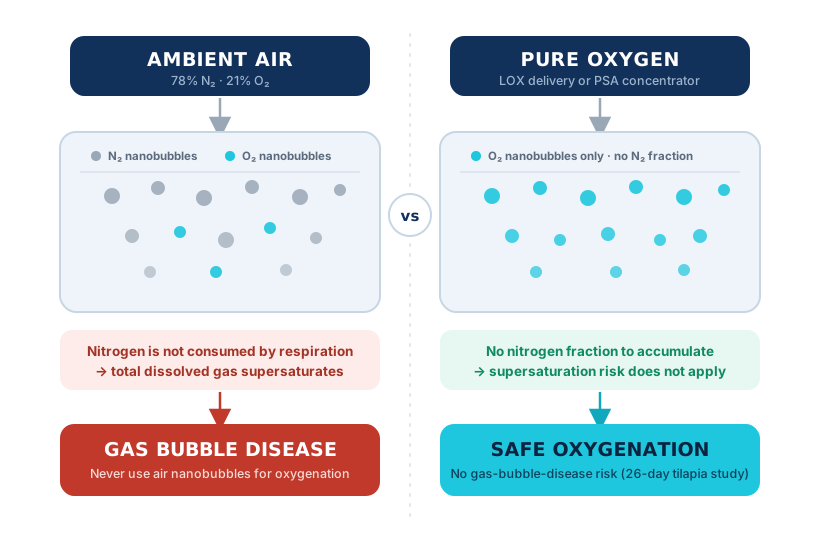
Worth noting: this doesn't mean air nanobubbles have zero place in a RAS. A 2025 study found air nanobubbles didn't meaningfully raise dissolved oxygen levels at all (consistent with air's low O₂ fraction limiting how much oxygen transfer is even possible), but did increase nitrifying bacteria abundance in the water and reduce biofilm accumulation on tank walls. So air nanobubbles may have a role in biofilter or fouling-control contexts specifically — they're just the wrong tool for oxygenation, where the nitrogen fraction is a genuine liability rather than an incidental one.
Since air is off the table for oxygenation, a nanobubble system needs a pure oxygen feed — either liquid oxygen (LOX) delivered and stored on-site, or an on-site oxygen concentrator (typically pressure swing adsorption, PSA). Neither is free. If a site doesn't already have an oxygen supply for other reasons, that infrastructure is a real, sometimes substantial, addition to the cost of a nanobubble system — it's not incidental to the technology, it's a precondition for using it safely at all.
Scale compounds this. Aquaculture systems, particularly ponds and larger RAS installations, involve large water volumes. Achieving meaningful dissolved oxygen uplift across that volume requires nanobubble generators and oxygen supply sized to match — considerably larger systems than would be needed for a comparable water-treatment application with a smaller flow. Any cost comparison against conventional aeration (blowers, paddlewheels, venturi injectors with an oxygen source) needs to account for both the generator and the oxygen supply, sized for the actual volume involved, not just the per-unit price of the nanobubble equipment itself.
Cost caveat aside, the underlying physics doesn't change: for a fixed gas volume, nanobubbles deliver dramatically more gas-water interfacial area than conventional aeration — the same A = 3V/r relationship covered on our technology page. Applied to oxygen specifically, that means faster, more complete oxygen transfer per unit of gas used, and higher achievable dissolved oxygen concentrations than blowers or diffusers typically reach.
In practice, that translates to two things a farm operator can actually use: lower mortality during periods of oxygen stress (warm water, high stocking density, transport), and the ability to sustain higher stocking densities for species that tolerate it, since dissolved oxygen is very often the binding constraint on how many animals a given water volume can support. A 2024 review covering a decade of aquaculture nanobubble research reported that air and oxygen nanobubble aeration produced significantly higher productivity, growth rate, total harvest, and survival rate across fish and shrimp farming studies, alongside lower oxygen consumption — though the same review flags that robust head-to-head comparisons against conventional micro- and macro-bubble aeration, and full economic feasibility analysis, are still thin. That's a genuine gap, not a reason to dismiss the technology — but it means the return on a nanobubble oxygenation system is site-specific and worth modelling before committing capital, not assuming from the general physics alone.
Bulk oxygenation is the obvious application, but the evidence base is arguably stronger — and the cost-to-benefit case often clearer — for three more targeted uses.
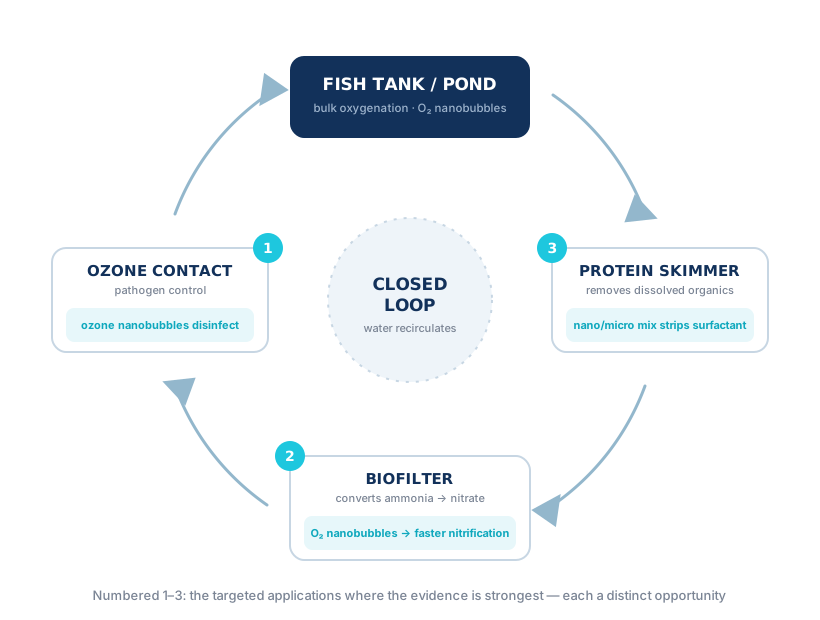
The same ozone nanobubble mechanism covered in our technology page literature review applies directly to aquaculture pathogens. Ozone nanobubbles have been shown effective against Vibrio parahaemolyticus (the shrimp AHPND pathogen) and, in a modified recirculation system, improved survival of Nile tilapia challenged with multidrug-resistant Aeromonas hydrophila — a genuine non-antibiotic disease-control pathway.
Nitrifying bacteria in a RAS biofilter are themselves aerobic, and their conversion of toxic ammonia and nitrite to nitrate is oxygen-limited just like the root-zone hypoxia covered in our agriculture guide. A pilot-scale study found nanobubble aeration sustained higher dissolved oxygen and greater biofilm microbial density in a moving-bed biofilm reactor than coarse-bubble aeration, translating to faster ammonia breakdown.
Protein skimmers work by exploiting exactly the interfacial-adsorption physics described on our technology page: dissolved organic matter and proteins (the "surfactants") preferentially adsorb onto rising bubble surfaces, get carried to the water surface, and form a foam that's physically skimmed off — stripping that material from the bulk water and, in the process, raising the bulk water's surface tension back toward that of pure water. See below for why nanobubbles specifically are a more complicated case than the other two.
The interfacial-adsorption mechanism above is only half the picture. Adsorbed surfactant doesn't just ride passively on a nanobubble's surface — a packed surfactant monolayer acts as a diffusion barrier that measurably slows gas exchange across the interface, which means it slows dissolution and extends the bubble's lifetime. This is well documented: surfactant-stabilized nanobubbles have been shown to dissolve more slowly than shelled microbubbles built specifically for stability, in direct dissolution-rate measurements.
That resolves the dissolution-timescale half of the concern, and it resolves it specifically in the skimmer's actual operating environment: aquaculture water is never clean, it's exactly the surfactant-rich condition under which nanobubbles gain extended life. It doesn't resolve the other half, though — buoyant rise velocity under Stokes' law depends on bubble radius, not lifetime, so a longer-lived nanobubble still isn't a fast-rising one. A working skimmer still needs something to physically carry adsorbed material up through a contact column into a skimmable foam layer. That's why a nano/microbubble mix — nanobubbles doing the high-surface-area surfactant scavenging, microbubbles providing the buoyancy to actually deliver it to the surface — is a more physically coherent design than nanobubbles alone. We haven't found a study testing this specific combination in a skimmer; it remains our reasoned extension of the mechanism rather than a cited finding.
Bohl, M. (1997). Gas bubble disease of fish [in German]. Tierärztliche Praxis, 25(3), 284–288.
Classic veterinary review defining chronic vs. acute gas bubble disease thresholds and symptoms. Predates the DOI system — no DOI exists, but the article is indexed on Europe PMC.
europepmc.org/article/med/9289892Yuan, Q., Du, J., Li, K., Zhu, B., Liang, R., & Wang, Y. (2025). Gas bubble trauma of Schizothorax prenanti at various life stages induced by total dissolved gas supersaturation. Ecotoxicology and Environmental Safety, 303, 118862.
doi.org/10.1016/j.ecoenv.2025.118862Linh, N.V., Khongcharoen, N., Nguyen, D.-H., Dien, L.T., Rungrueng, N., Jhunkeaw, C., Sangpo, P., Senapin, S., Uttarotai, T., Panphut, W., St-Hilaire, S., Van Doan, H., & Dong, H.T. (2023). Effects of hyperoxia during oxygen nanobubble treatment on innate immunity, growth performance, gill histology, and gut microbiome in Nile tilapia, Oreochromis niloticus. Fish & Shellfish Immunology, 143, 109191.
Found no signs of gas bubble disease and no adverse effects on survival or growth after 26 days of oxygen (not air) nanobubble exposure at ~24 mg/L DO.
doi.org/10.1016/j.fsi.2023.109191Sean, A., Lim, T.S., Domingos, J.A., Uichanco, J.A., Shen, X., & Gibson-Kueh, S. (2025). Air nanobubbles enhance viable bacteria counts, abundance of nitrifying bacteria, and reduce nitrite levels in marine recirculation aquaculture systems. Fishes, 10(11), 550.
Air nanobubbles did not significantly raise dissolved oxygen, but did increase nitrifying bacteria abundance and reduce tank-wall biofilm — the basis for the air-vs-oxygen nuance above.
doi.org/10.3390/fishes10110550Yaparatne, S., Morón-López, J., Bouchard, D., Garcia-Segura, S., & Apul, O.G. (2024). Nanobubble applications in aquaculture industry for improving harvest yield, wastewater treatment, and disease control. Science of the Total Environment, 931, 172687.
Comprehensive review of a decade of aquaculture nanobubble research; explicitly notes the lack of robust macro/microbubble comparisons and economic feasibility data.
doi.org/10.1016/j.scitotenv.2024.172687Imaizumi, K., Tinwongger, S., Kondo, H., & Hirono, I. (2018). Disinfection of an EMS/AHPND strain of Vibrio parahaemolyticus using ozone nanobubbles. Journal of Fish Diseases, 41(4), 725–727.
Also cited on our technology page; directly relevant to shrimp disease control.
doi.org/10.1111/jfd.12783Dien, L.T., Linh, N.V., Sangpo, P., Senapin, S., St-Hilaire, S., Rodkhum, C., & Dong, H.T. (2021). Ozone nanobubble treatments improve survivability of Nile tilapia (Oreochromis niloticus) challenged with a pathogenic multi-drug-resistant Aeromonas hydrophila. Journal of Fish Diseases.
doi.org/10.1111/jfd.13451Suriasni, P.A., Faizal, F., Panatarani, C., Hermawan, W., Subhan, U., Fitrilawati, F., & Joni, I.M. (2025). Enhancing biofilm performance and ammonia removal in MBBR systems using nanobubble aeration: A pilot-scale experimental study. Water, 17(22), 3215.
doi.org/10.3390/w17223215Fisheries Research and Development Corporation (FRDC). Evaluation of Nanobubble Technology in Aquaculture. Project 2019-139.
Australian government aquaculture R&D report; states plainly that no reliable efficacy studies existed at time of writing — an appropriately cautious source worth reading alongside the more bullish literature above.
frdc.com.au/project/2019-139Peng, L., Oh, S.-Y., & Jo, J.-Y. (2003). Protein removal by a foam fractionator in simulated seawater aquaculture system. Ocean and Polar Research, 25, 269–275.
Ties foam fractionation efficiency to superficial air velocity, the general mechanism underlying the protein skimmer discussion above — not a nanobubble-specific study.
doi.org/10.4217/OPR.2003.25.3.269Wu, H., Rognin, N.G., Krupka, T.M., Solorio, L., Yoshiara, H., Guenette, G., Sanders, C., Kamiyama, N., & Exner, A.A. (2013). Acoustic characterization and pharmacokinetic analyses of new nanobubble ultrasound contrast agents. Ultrasound in Medicine & Biology, 39(11), 2137–2146.
Measured surfactant-stabilized nanobubbles dissolving slower than clinically-used shelled microbubbles (Definity dissolved 1.67× faster) — direct quantitative evidence that surfactant loading extends nanobubble lifetime, the basis for the refined skimmer mechanism above.
doi.org/10.1016/j.ultrasmedbio.2013.05.007Whether it's bulk oxygenation, disinfection, biofilter performance, or something more specific to your system, Inpelor provides independent, vendor-neutral guidance on what's actually worth the capital investment.
Request a Consultation →